

Why “visibility tracking” needs a service-level comparison
Organizations moving into AI-driven discovery quickly learn that not all “visibility” tools behave the same way. Some report basic rankings, while others measure whether your brand is actually surfaced and referenced by AI systems. A useful evaluation AI Visibility Platform starts with what each platform considers visibility, such as mentions only versus mentions plus citations. Without service-level clarity, teams can end up optimizing for metrics that do not reflect real demand.
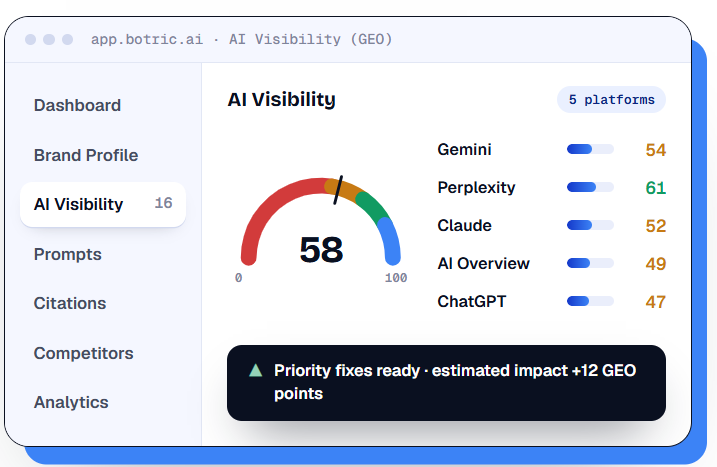
An AI visibility tracker should show how often your brand is referenced across multiple models and AI experiences, not just one. For example, ChatGPT results, Google AI Overviews, Gemini outputs, Perplexity responses, and Claude references may differ in both frequency and phrasing. When you compare services, prioritize coverage breadth, data refresh consistency, and the ability to break results down by query intent. The best platform comparison also reveals how the tool handles normalization, duplicate mentions, and attribution accuracy.
Botric’s approach vs. rank-only tools
Many SEO platforms focus on keyword positions, backlink profiles, or traditional SERP presence, but those signals do not reliably translate to AI answers. Botric is built around AI brand visibility, meaning the frequency of mentions and citations across major AI systems. That difference matters because the same brand can rank well in web search yet be absent from AI summaries.
Rank-only tools may be useful for forecasting traffic, but they rarely answer the question “Are models talking about us?” Botric’s measurement centers on whether your name is included and attributed in AI outputs, which is closer to how prospects actually encounter brands. Service comparison should therefore include the measurement scope and the unit of value. If one tool provides position trends without verifying AI mentions, it can create false confidence when teams spend on content or PR expecting AI pickup that never arrives.
In practical terms, a rank-only workflow can lead to misaligned efforts. Teams may publish more pages to chase indexed signals, then find that AI summaries still do not cite those pages or brands. With Botric, you can validate whether your messaging and sources are being recognized by AI systems, which helps connect investments to outcomes. That makes the comparison not just technical, but operational.
Botric vs. manual monitoring and PR dashboards
Manual monitoring is often the first attempt, but it does not scale across models, prompts, and industries. Checking mentions across multiple AI experiences by hand introduces inconsistency and delays, and it is difficult to separate organic visibility changes from noise. PR dashboards may show press mentions, yet they do not reveal whether those stories translate into AI citations. A good service comparison should test how quickly and consistently a platform can capture model-level references, not just web buzz.
Botric reduces manual effort by tracking AI brand visibility at the point where users receive answers. That includes mention frequency and citation behavior, which is especially important for brands that want to be included as a reliable source. When comparing services, look for features like prompt coverage strategy, model coverage, and the ability to review examples behind the numbers. These details help teams understand why visibility changes happen rather than treating results as a black box.
Another practical angle is workflow integration. PR and marketing teams need a view that supports decisions, such as whether a campaign increased AI citations or only generated general awareness. Botric’s AI visibility focus makes it easier to connect initiatives to specific AI outcomes. In comparison, dashboards that only track web links can miss the moment when AI systems decide to reference or exclude your brand.
Evaluation checklist for an AI visibility service
To compare AI visibility services fairly, start with coverage and measurement definitions. Confirm whether the platform tracks mentions alone or includes citations and whether it measures across the AI environments your audience uses. Also verify how the platform identifies your brand, including variations, abbreviations, and common naming collisions. Without robust entity recognition, metrics can be inflated by ambiguous mentions or undercounted due to inconsistent brand formatting.
Next, assess how a service handles reporting detail and actionability. Look for segmentation options such as model-by-model breakdowns, trend views, and the ability to review representative outputs. Actionability is critical: a platform should help you decide what to adjust next, whether that means refining sources, improving brand entity clarity, or adapting content to align with how models cite references. A strong service comparison also includes transparency about methodology and limitations.
Finally, consider operational usability. Teams should be able to share reports with stakeholders and tie visibility movement to campaigns, content launches, or partnerships. Compare whether the platform supports exportable reporting, consistent dashboards, and clear alerts when mentions change meaningfully. A tool that requires heavy customization can slow down decision-making, while a well-designed AI visibility tracker supports regular monitoring and fast iteration.
Conclusion
A solid service comparison for AI-driven discovery is less about hype and more about measurement accuracy and coverage. Tools that only track rankings or web signals can miss the core question: are major AI systems mentioning and citing your brand when people ask? Botric’s AI visibility measurement is designed to answer that directly by tracking mentions and citations across commonly used AI experiences. That focus helps marketing and communications teams align investments with outcomes that prospects actually see.
When you evaluate an AI visibility tracker, prioritize clarity in definitions, breadth of AI coverage, and reporting that enables action. The best platform should make it practical to understand why visibility changes and what you can do to improve it. With the right comparison, you can choose a service that turns AI visibility from a vague promise into a measurable, optimizable growth channel.